
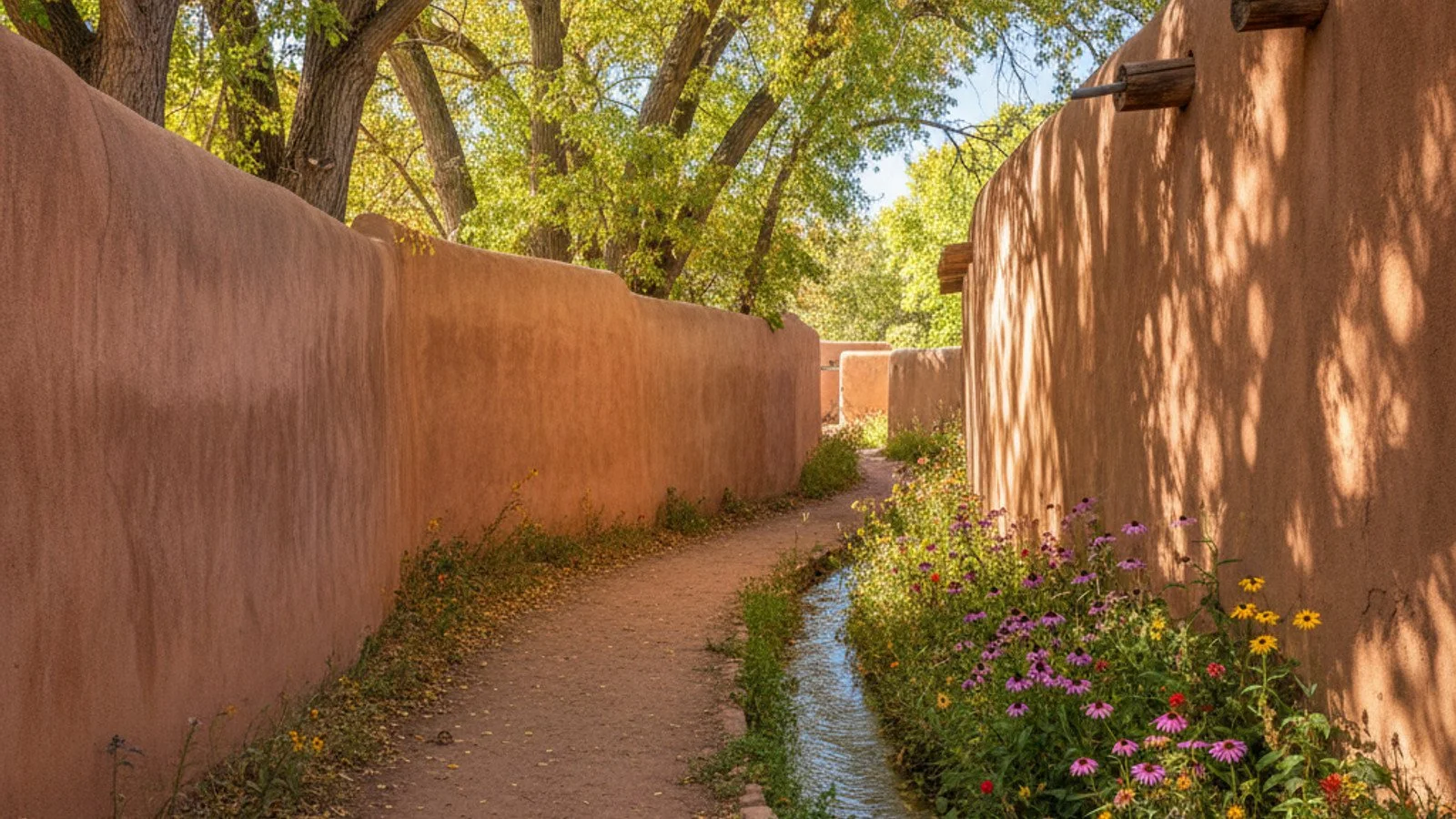
If you have ever walked down a narrow, winding dirt lane in Santa Fe, smelled the scent of piñon wood smoke in the air, and wondered what lies behind those high adobe walls, you have likely experienced the Historic Eastside.
This neighborhood is often called the "Soul of Santa Fe." Nestled between the bustling Santa Fe Plaza and the rising foothills of the Sangre de Cristo Mountains, it offers an atmosphere you simply cannot replicate in newer developments. It is quiet, incredibly private, and steeped in an "Old World" charm that feels centuries removed from modern life.
The architecture here is strictly protected, dominated by the Pueblo Revival and Territorial styles that give Santa Fe its signature look. For buyers, this is one of the most coveted neighborhoods in the Southwest—not just for the prestige, but for the unique feeling of living inside a piece of living history.
Let’s explore what life is actually like in this district, from the lifestyle and housing market to the regulations you need to know before signing a contract.
The Lifestyle: Canyon Road, Culture, and Walkability
Living in the Eastside means striking a balance between residential seclusion and world-class culture. While your home might feel like a hidden compound, you are often just steps away from Canyon Road, an iconic half-mile stretch housing over 100 art galleries, boutiques, and fine dining establishments. It is rare to find a neighborhood where you can enjoy total silence in your garden and then walk five minutes to view world-renowned art or grab a coffee.
A defining feature of the area is the Acequia Madre (the "Mother Ditch"). This historic irrigation ditch, which still carries water seasonally, winds through the neighborhood and is lined with massive cottonwood trees. The dirt paths alongside the acequia serve as the neighborhood’s unofficial walking trails, popular for morning dog walks and evening strolls.
In terms of getting around, this is a true "walking neighborhood." Most homes are a 15 to 20-minute walk to the Plaza. However, don't expect standard suburban sidewalks. The lanes here are often narrow, paved with dirt or uneven asphalt, and bounded by coyote fences or stucco walls. It adds to the charm, but it means you’ll want comfortable shoes rather than stilettos when heading out for dinner.
The privacy here is also a major draw for luxury buyers. The architecture is designed to turn inward; homes are often hidden behind high walls with gated courtyards, creating a sanctuary that feels miles away from the tourists exploring nearby galleries.
Historic Eastside Real Estate Market
When you look at luxury homes for sale in Santa Fe, the Historic Eastside usually commands the highest price per square foot in the city. The housing stock here is unique; you aren't buying a cookie-cutter build. Many of these homes are authentic adobes dating back to the 1800s or even earlier. You will find classic features like kiva fireplaces, vigas (exposed ceiling beams), and latillas (peeled branches arranged between beams) in almost every property.
Because of the history and location, the price point is significant. Entry-level opportunities—often smaller casitas or homes needing work—usually start near $1M. For fully restored estates or compounds with guest houses, prices typically range from $3M to over $10M. It is not uncommon for the price per square foot to exceed $500 or even $700, depending on the level of finish and historical provenance.
Inventory in the Eastside is historically tight. Because this is a destination neighborhood, homes often sell off-market or go under contract within days of listing. If you are serious about this area, you need to be ready to move quickly.
A quick note on investment potential: If you are considering offsetting costs with rentals, be aware that the City of Santa Fe has strict short-term rental ordinances. Permits are capped and regulated, especially in residential zones, so never assume you can Airbnb a property without checking the current status first.
Buying in a Historic District: What You Need to Know
If you fall in love with a home here, there is one governing body you must become familiar with: the Historic Districts Review Board (HDRB), often just called the "H-Board" by locals.
The Eastside is a protected historic district, which means you cannot simply knock down walls or change the exterior of your home at will. The HDRB manages these regulations to preserve the streetscape.
Exterior Changes: Almost any change to the exterior—including replacing windows, changing the stucco color, re-roofing, or altering a garden wall—requires approval.
Contributing vs. Non-Contributing: This is the most critical term to learn. A "Contributing" property is one that adds to the historic character of the district (usually older structures). These have the strictest protections. A "Non-Contributing" property (usually newer builds) has slightly more flexibility, but still falls under strict design codes.
Common Restrictions: You generally cannot use vinyl windows; you must use specific wood or clad-wood options. Stucco colors are limited to a specific palette of earth tones.
Before you close on a home, review the property’s file at the Land Use department to ensure all past renovations were permitted. It is also smart to budget for ongoing stucco maintenance, as authentic adobe requires care to protect it from the elements.
Schools and Education
For those moving to the area with education in mind, the Eastside offers convenient access to several institutions.
Acequia Madre Elementary is located directly within the neighborhood. It is well-regarded locally and is known for integrating the arts into its curriculum, fitting for a school surrounded by galleries.
For private education, the location is central. Santa Fe Preparatory School and the Rio Grande School are both a short drive away. Because the Eastside is so central, commuting to various educational campuses across the city is generally straightforward, avoiding the heavier traffic found on the city's south side.
Environment and Safety: Fire, Flood, and Terrain
While the Eastside is beautiful, it is important to understand the environmental realities of the terrain.
The neighborhood sits at the base of the foothills, an area known as the Wildland-Urban Interface (WUI). This means the forest meets the city here. Fire safety is taken seriously; homeowners are required to maintain "defensible space" around their property. This usually involves keeping trees trimmed, clearing dry brush, and ensuring that vegetation doesn't bridge the gap between the wild foothills and your home.
Water is another factor. The Santa Fe River and the Acequia Madre run through the area. While the river is often dry, summer monsoons can bring sudden, heavy rains. Flash floods in the arroyos are a real phenomenon. Some properties may lie within FEMA flood zones, so it is essential to check if a specific property requires flood insurance.
Finally, consider the terrain in winter. The Eastside is hilly, and those charming narrow lanes can be tricky to navigate after a snowstorm. While the city plows priority routes, having a vehicle with all-wheel drive is a practical choice for living in the foothills.
Pros and Cons of Living in the Historic Eastside
If you are weighing your options, here is a quick snapshot of the trade-offs involved in living in this specific neighborhood.
Pros:
Unmatched Character: You are living in a piece of art. The historic charm is authentic and legally protected.
Walkability: You can walk to some of the best dining and art galleries in the country.
Value Retention: This is a "blue chip" neighborhood; property values tend to be resilient due to high demand and limited supply.
Privacy: High walls and compounds offer a secluded lifestyle in the heart of the city.
Cons:
Strict Regulations: The HDRB rules can be frustrating if you want to renovate or expand.
Maintenance: Adobe homes and flat roofs require more upkeep than standard construction.
Parking & Streets: Narrow streets can make guest parking difficult, and navigation is tight.
Cost: You are paying a premium for the location and history.
Frequently Asked Questions
Does the Historic Eastside have an HOA?
No, there is no central Homeowners Association for the neighborhood. However, the City of Santa Fe’s Historic Districts Review Board (HDRB) acts as a governing body for exteriors, enforcing strict rules that are often more rigorous than a standard HOA.
Is the Historic Eastside walkable?
Yes, it is highly walkable to the Plaza and Canyon Road, making it ideal for a pedestrian lifestyle. However, be aware that many residential lanes lack sidewalks and streetlights, so walking at night or in winter requires caution.
What are the restrictions on renovating a home in the Historic Eastside?
Any exterior change visible from the street—including windows, stucco, gates, and roof height—requires a permit and often a hearing with the HDRB. If your home is designated as a "Contributing" property, you will face significant restrictions on demolition or altering the primary facade.
Is the Historic Eastside safe from wildfires?
Because the neighborhood borders the foothills (the Wildland-Urban Interface), there is an elevated risk compared to the city center. Homeowners mitigate this by following strict vegetation management codes to create defensible space around their structures.