
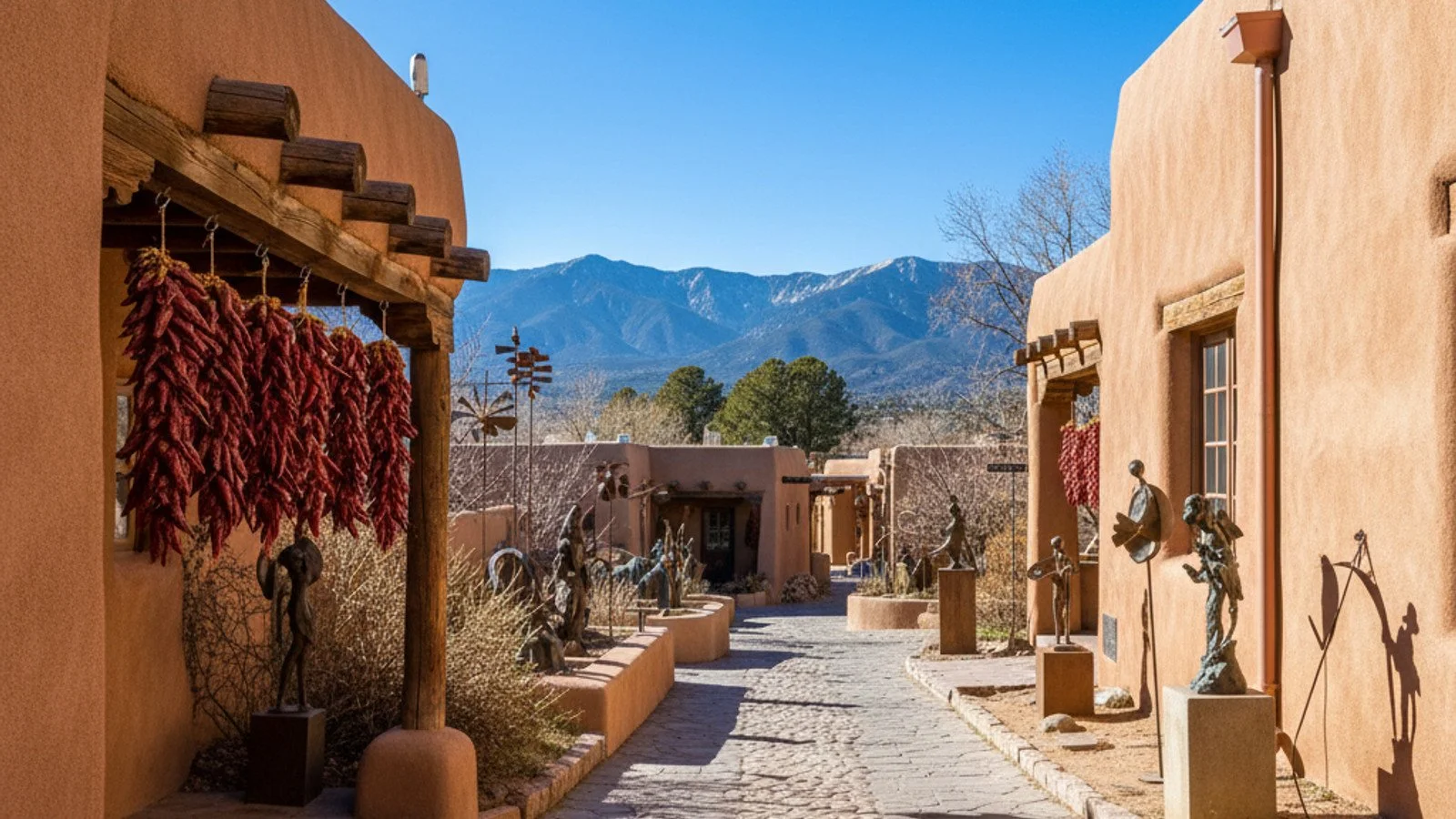
If you ask anyone who lives here to describe the heart of Santa Fe’s cultural scene, they usually point you toward the "Magical Half-Mile." Canyon Road isn't just a street; it is the densest concentration of art galleries in the entire country, weaving through the historic fabric of the city.
For visitors and potential homebuyers alike, this area offers a sensory experience you can’t really find anywhere else. As you walk the gentle incline, the smell of piñon wood smoke often hangs in the air, dried chili ristras hang from portals, and the Sangre de Cristo Mountains provide a perfect backdrop.
Before you head over, there is one common confusion to clear up. Because it is a famous destination, many people ask if Canyon Road is "open." The road itself is a public street, so you can walk or drive it 24/7. However, the galleries and businesses generally operate from 10:00 AM to 5:00 PM. While the road is beautiful at sunrise, the doors won't open until mid-morning.
From Humble Footpath to World-Class Art Colony
To understand the real estate and the vibe here, you have to look at the history. Long before it was a destination for fine art, this road was a humble farming trail running alongside the Acequia Madre (the "Mother Ditch"), which still irrigates the trees and gardens today. It was the route wood haulers used to bring firewood down from the mountains into the city center.
The transformation into an art colony really began in the 1920s. A group of artists known as "Los Cinco Pintores" (The Five Painters) moved in and began building their own adobe homes. They were young, broke, and looking for a cheap place to live and paint. Today, those "humble" homes are some of the most desirable properties in the Southwest.
As you explore, keep an eye out for historic landmarks that anchor the neighborhood. El Zaguan, home to the Historic Santa Fe Foundation, is a stunning example of a hacienda-style building with a garden that feels like a secret oasis. You might also spot the Olive Rush House and Studio, which serves as a testament to the Quaker artist who helped shape the district's identity. This history dictates the architecture you see today—low-slung buildings, thick adobe walls, and narrow streets that were never designed for modern SUVs.
Navigating the Galleries: A Collector’s Paradise
With over 80 to 100 galleries packed into such a short stretch, it can be overwhelming to know where to start. The variety here is staggering. You aren't just looking at one style; you will find everything from contemporary abstract paintings and large-scale wind sculptures to traditional Native American pottery and Navajo weavings.
One of the unique features of Canyon Road is the "sculpture garden" culture. Unlike big city galleries that are purely indoor spaces, many properties here have deep front yards filled with bronze and kinetic art. It encourages a slower pace where you browse outside before stepping in.
If you are planning a day of viewing, here is a simple strategy: Start at the bottom of the road (near Paseo de Peralta) and work your way up.
Contemporary Art: You’ll find incredible modern works and kinetic wind sculptures (like those at Wiford Gallery) that move with the breeze.
Western & Traditional: As you wander, you will see classic oil paintings capturing the Western landscape and cowboy culture.
Historic Gems: Don't miss the smaller, tucked-away spots like the Meyer Gallery, which often feature incredible regional artists.
Where to Eat: Canyon Road Restaurants & Dining
Walking the road is a workout—it is a steady uphill climb—so knowing where to refuel is essential. The dining scene here is just as artistic as the galleries, often housed in centuries-old buildings that add to the atmosphere. These aren't just tourist stops; they are culinary destinations in their own right.
Geronimo: Located in the historic Borrego House (built in 1756), this is often cited as one of the best restaurants in Santa Fe. It offers global eclectic fine dining and is perfect for a celebratory dinner.
The Compound Restaurant: Famous for its design by Alexander Girard, this spot focuses on seasonal menus and has one of the most beautiful patios in the city.
El Farol: This is Santa Fe’s oldest restaurant and bar. It is the place to go for tapas, steaks, and world-class flamenco shows. The walls are covered in murals painted by early artists who traded art for drinks.
The Teahouse: If you want something more casual, this is a local favorite located at the top of the commercial district. They have a massive tea selection and great breakfast and lunch options.
Living on Canyon Road: Historic Eastside Real Estate
For many of my clients, buying a home in the Historic Eastside is the ultimate Santa Fe dream. When we look at homes for sale in this area, we aren't just buying square footage; we are buying a piece of history.
The housing stock here is distinct. You are looking at authentic adobe homes, many of which date back a hundred years or more. These properties often feature kiva fireplaces, thick plaster walls, and vigas (exposed ceiling beams). Because the lots were originally agricultural, many homes are hidden behind high coyote fences or adobe walls, creating private compounds with lush courtyards that you would never guess exist from the street.
However, potential buyers should be prepared for the market reality. Because of the scarcity of land and the prestige of the location, price per square foot here is among the highest in the city. Zoning is also very strict. The Historic Design Review Board ensures that the "Old World" charm remains intact, which is great for property values but means renovations require careful planning.
Living here offers a lifestyle you can't replicate. You are within walking distance to world-class dining and art, yet once you close your garden gate, it is incredibly quiet and private.
Signature Events: The Farolito Walk & Paint Outs
While the road is active year-round, there are certain times when the community really comes alive.
The most famous event is arguably the Christmas Eve Farolito Walk. On December 24th, the city closes the road to cars, and thousands of people walk the street. The area is lit by thousands of "farolitos" (small paper bags filled with sand and a candle) and "luminarias" (small bonfires made of stacked piñon wood). It is a silent, glowing spectacle that feels almost spiritual.
In the summer, the vibe changes with various Paint Outs. During these weekends, artists set up easels on the sidewalks and paint live. It is a fantastic way to meet the artists and see the creative process firsthand. You might also catch the Edible Art Tour, a charity event that pairs galleries with top local chefs.
Visitor Logistics: Parking, Hours, and Tips
If you are planning a visit or scouting the neighborhood, here are the answers to the most common logistical questions we get.
What time does Canyon Road Santa Fe open and close?
Canyon Road is a public street, so it never technically "closes." However, the galleries and shops generally open their doors around 10:00 AM and close by 5:00 PM. If you want to see the art, that is your window, though evening dining keeps the street lively after dark.
Where do you park to walk Canyon Road?
Parking is the biggest challenge here. There is very limited street parking, and the road is narrow. Your best bet is the paid parking lot at the bottom of the road (near Paseo de Peralta). You can sometimes find parallel parking on side streets like Acequia Madre, but be very careful not to block driveways, as towing is enforced.
How long does it take to walk Canyon Road?
If you power-walked from the bottom to the top without stopping, it would take about 45 minutes. However, nobody does that. To truly enjoy the galleries and gardens, plan for at least 2 to 4 hours.
Is Canyon Road residential or commercial?
It is a unique blend of both. While the main frontage is dominated by commercial galleries and restaurants, the properties immediately behind and between them are high-end residential homes. This mix is what gives the Historic Eastside its vibrant, lived-in character.