
Purchasing a property in Northern New Mexico requires looking beyond the listing price to understand the full cost of ownership. Buyers often find that properties with similar asking prices have vastly different monthly carrying costs depending on the neighborhood.
Factoring in homeowner association dues is an essential step when looking at homes for sale in Santa Fe. These monthly or quarterly assessments fund everything from basic road maintenance to extensive recreational facilities.
The unique topography and climate of the high desert mean that community upkeep requires specialized attention. Understanding exactly what you get for your money helps ensure your new home aligns with your long-term financial goals.
The Basics of HOA Fees in Santa Fe, NM
The typical homeowner association costs in the Santa Fe market vary widely depending on the type of community. For an average single-family neighborhood, buyers can expect to see fees ranging from roughly $150 to $400 per month.
These assessments scale with the median home price and fund the fundamental operating budget of the community association. Management companies use these funds to pay for ongoing maintenance, liability insurance for shared spaces, and administrative overhead.
Evaluating the HOA assessment is just as critical as checking the MLS price before submitting an offer. A low purchase price might look appealing on paper, but a steep monthly association fee can easily push the property out of your target budget.
Buyers should also be aware that communities with unusually low monthly dues might occasionally rely on special assessments. This happens when the association needs to fund a major unexpected repair and does not have enough money saved in the reserve account.
What Do HOA Fees Cover in New Mexico?
Dues fund the specific amenities and maintenance services required to keep a subdivision functioning smoothly. In Santa Fe County, certain environmental factors make community upkeep particularly important for daily access and comfort.
Winter weather at higher elevations requires reliable plowing, while heavy summer monsoons necessitate frequent grading for unpaved community roads. A well-managed operating budget typically covers several key areas that justify the monthly expense:
Maintenance of common areas, with a heavy emphasis on private road grading and winter snow removal.
Upkeep for shared neighborhood amenities such as community centers, swimming pools, walking trails, or parks.
Enforcement of a covenant (law) and architectural restrictions designed to protect overall property values.
Structural insurance and exterior building maintenance for attached housing types like townhomes.
Condo vs. Single-Family Home HOA Costs
Property types dictate the fee structure you will encounter during your real estate search. Condominiums typically command much higher monthly fees than standalone houses because the association handles significantly more responsibility.
Condos in Santa Fe can easily exceed $500 to $1,000 per month depending on the location, building age, and included amenities. These higher condo fees usually cover exterior building maintenance, roof repairs, master insurance policies, and sometimes even basic utilities like water and trash service.
Single-family homes generally see lower association costs ranging from $100 to $300 per month, which are frequently billed on a quarterly basis. The trade-off is that single-family homeowners must pay out-of-pocket for their own exterior stucco upkeep, roof replacements, and individual landscaping.
Downtown condominium units often sit at the higher end of the fee spectrum due to the costs associated with maintaining historic building facades. Conversely, newer single-family developments on the edge of town often have lower, highly predictable quarterly assessments.
Santa Fe Neighborhoods and Their HOA Fee Structures
Santa Fe features a wide variety of neighborhood associations, ranging from rural dirt-road subdivisions to dense master-planned communities. Buyers must carefully align their amenity expectations with their monthly budget capacity when choosing an area.
Looking at different developments highlights how drastically the community management approach changes from one zip code to the next. Some subdivisions prioritize extensive shared facilities, while others focus purely on minimal road maintenance to keep costs low.
Lower fees are not always better if they indicate the community management is deferring necessary maintenance or lacks a healthy reserve fund. Buyers should always request the HOA budget and reserve study during the closing process to ensure the association is financially stable.
Reviewing these documents reveals whether the neighborhood association is proactively saving for future road repaving or roof replacements on shared buildings. A well-funded reserve account protects homeowners from sudden, massive out-of-pocket requests.
Master-Planned Communities: Aldea and Rancho Viejo
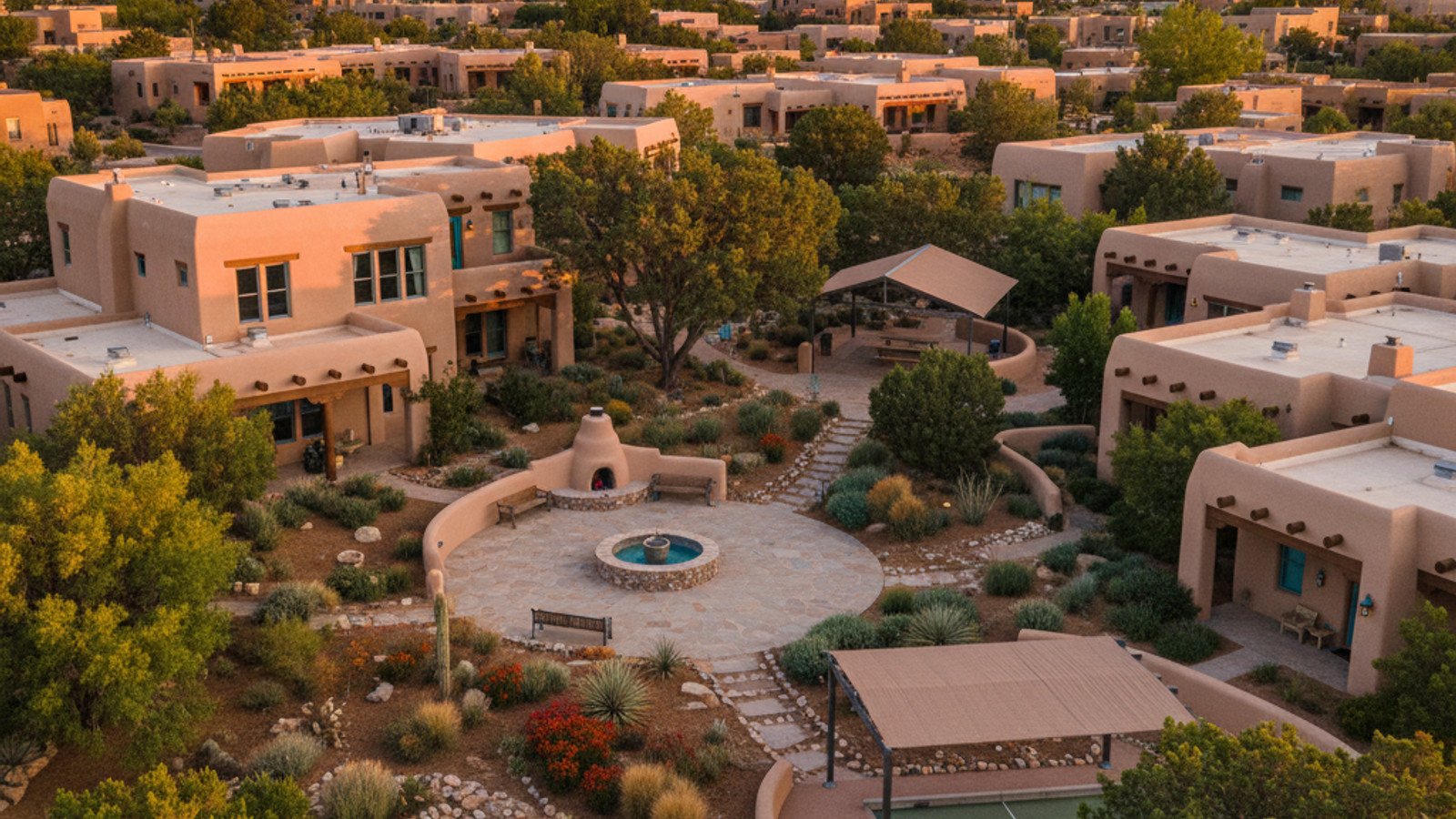
Master-planned developments offer a highly structured environment with extensive shared spaces and cohesive architectural styles. Rancho Viejo is known for its miles of paved walking trails, village plazas, and open community parks. Residents in Rancho Viejo typically pay quarterly fees of roughly $260 to $380, depending on which specific village they purchase in.
Aldea de Santa Fe offers a different aesthetic with its New Urbanist design, central plaza, community center, and recreational courts. The quarterly fees in Aldea run approximately $490, which covers the ongoing maintenance of these extensive community features.
Both of these communities utilize professional management companies to handle the day-to-day operations and enforce the neighborhood covenants. This ensures that the shared spaces remain in excellent condition year-round without requiring volunteer labor from the residents.
Luxury and Resort Communities: Las Campanas
High-end communities provide expansive amenities and premium services that require a much larger financial commitment. The Master Association fees for living in luxury developments like Las Campanas run approximately $3,800 to $4,000 or more annually.
These higher-tier dues fund 24/7 security gates, roaming patrols, paved private roads, and on-site paramedics. It is important to note that specific enclaves within these luxury communities may have additional sub-association fees that range much higher to cover specialized landscaping.
Buyers should also understand the strict distinction between mandatory HOA dues and optional club memberships. Access to golf courses, equestrian centers, or private social clubs typically requires separate initiation fees and monthly dues outside of the standard association assessment.
How HOA Fees Factor Into Your Total Housing Budget
Association dues directly impact the overall cost of homeownership and your ability to secure mortgage approval in Santa Fe. Lenders factor monthly HOA dues into a buyer's debt-to-income ratio during the strict underwriting process.
A higher monthly assessment reduces the amount of principal and interest you can qualify to borrow from the bank. This means a property with a $500,000 purchase price and a high association fee might be harder to finance than a more expensive home with no dues.
Property taxes in Santa Fe County are generally lower outside the city limits, which can sometimes help offset the cost of higher HOA fees in county subdivisions. Many buyers find that the tax savings in these outlying areas make the community association dues much more manageable.
Buyers must calculate the total monthly payment - including principal, interest, taxes, insurance, and HOA - to understand true affordability rather than just focusing on the purchase price. Looking at the complete financial picture prevents stressful surprises after closing.
Frequently Asked Questions
How do you find out HOA fees in Santa Fe, NM?
The most accurate way to find current fees is to check the specific MLS listing or ask your real estate agent to request the governing documents. Sellers are required to disclose all mandatory association assessments and payment schedules during the transaction.
Are HOAs regulated in New Mexico?
Yes, community associations are regulated under state law, primarily through the New Mexico Homeowner Association Act. This legal framework dictates how associations must handle disclosures, financial records, and the enforcement of neighborhood rules.
Do HOA fees affect mortgage approval?
Association dues absolutely impact your mortgage approval process by increasing your total monthly housing expense. Lenders include these fees when calculating your debt-to-income ratio, which determines the maximum loan amount you can comfortably afford.