
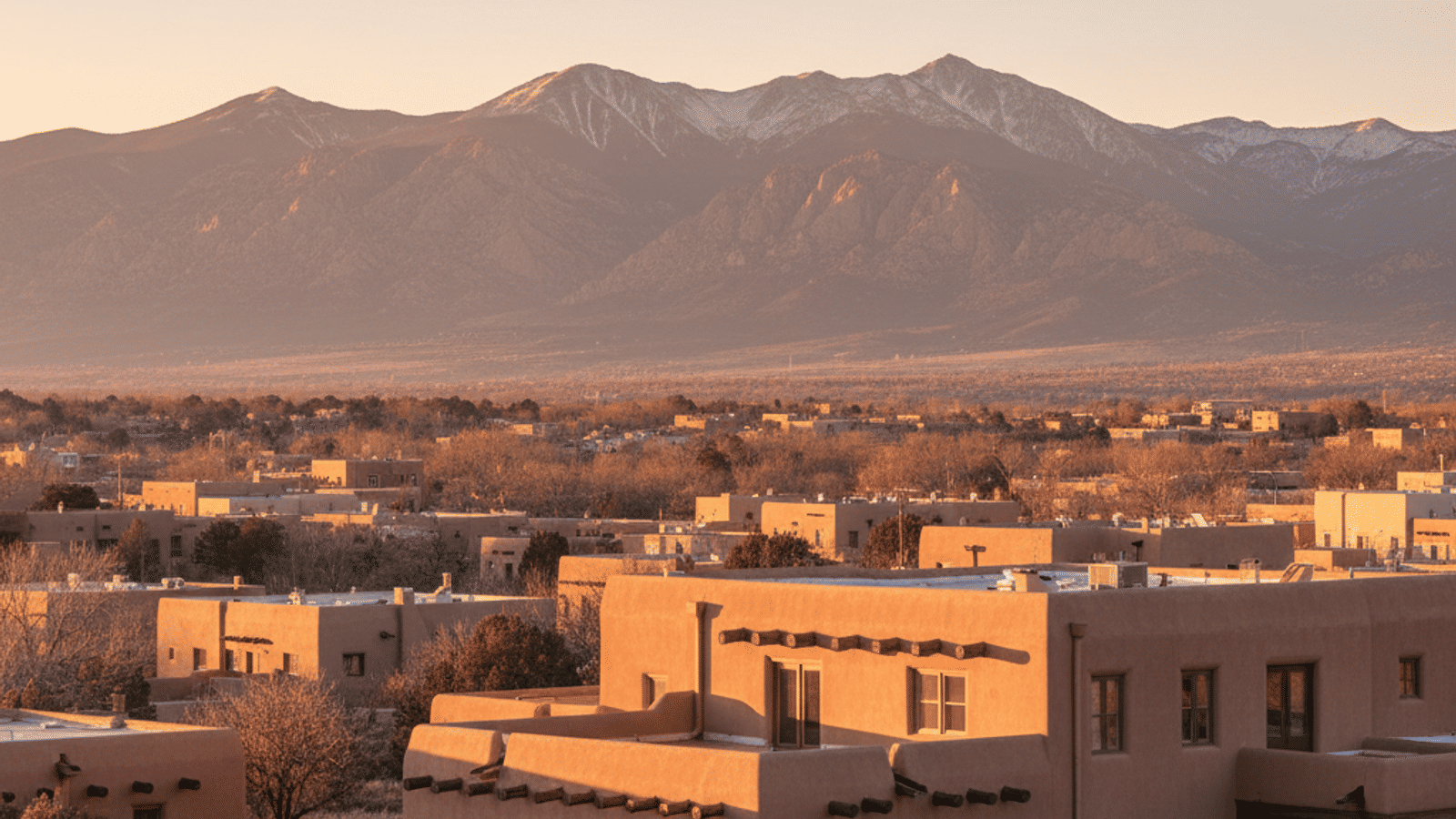
There is a reason people call Santa Fe "The City Different." If you are looking for rows of identical stucco houses and flat, humid golf courses, this probably isn't the place for you. But if you want crisp mountain air, a culture that blends Native American history with Spanish heritage, and a retirement filled with gallery openings rather than just bingo nights, you might have found your home. For more on the general lifestyle, consider reading about living in Santa Fe.
Santa Fe sits at about 7,200 feet above sea level, nestled at the foot of the Sangre de Cristo Mountains. With a population of around 90,000, it manages to feel like a small town where you run into neighbors at the grocery store, yet it boasts the cultural amenities of a major metropolis. It’s a unique dynamic that draws a specific type of retiree: creative, active, and usually looking for something a bit more soulful than the standard sunbelt retirement.
Before we dive into the specific neighborhoods, it is important to understand that Santa Fe doesn't follow the typical Florida or Arizona retirement script. You won't find massive, 5,000-home age-restricted tracts here. Instead, the market is a mix of age-targeted luxury neighborhoods, boutique 55+ condo communities, and full-service independent living resorts.
Why Choose Santa Fe for Retirement?
People usually fall in love with Santa Fe for the romance of it—the adobe architecture and the famous "Santa Fe light"—but they stay for the lifestyle. It offers a rare balance of intellectual stimulation and physical activity that is hard to find elsewhere in the Southwest.
The Arts: You can’t talk about Santa Fe without mentioning the art scene. With over 250 galleries, primarily concentrated on Canyon Road, art isn't just a hobby here; it's the industry. For music lovers, The Santa Fe Opera offers world-class open-air performances that are a staple of the summer social calendar.
The Outdoors: If you love to hike, this is paradise. You have immediate access to trails in the Sangre de Cristo Mountains and a mild four-season climate. We get over 300 days of sunshine a year, and while we do get snow, it usually melts by the afternoon in the city, leaving the powder for the skiers up at the basin. To learn more about activities, check out things to do in Santa Fe.
Tax Benefits: New Mexico has become increasingly friendly to retirees. Property tax rates are among the lowest in the U.S. (often around 0.78%), and the state has implemented exemptions for Social Security income, which can be a huge relief for your monthly budget.
The Vibe: The pace here is relaxed—sometimes notoriously so (we call it "mañana time"). It is a wellness-focused, intellectual community where people are just as likely to discuss philosophy or pottery techniques as they are the stock market.
Understanding Santa Fe’s Retirement Landscape
When you start looking at retirement communities in Santa Fe NM, you’ll quickly realize there are three distinct paths you can take. Understanding these differences early will save you a lot of time on your property search.
First, you have Active Adult (Ownership). This is where you buy a condo or single-family home in a neighborhood designed for an older demographic. These may offer clubhouse amenities and handled exterior maintenance, but you own the real estate.
Second, there is Independent Living (Rental). These are full-service communities where you pay a monthly rent that covers dining, housekeeping, and activities. You don’t have a mortgage, but you don’t build equity either.
Finally, you have Life Plan Communities (CCRC). Places like El Castillo require a significant upfront buy-in fee. In exchange, you get a residence and a guarantee of future care (assisted living or nursing) if your health needs change later in life.
Top Active Adult & Lifestyle Communities (Ownership)
If you want to own your home but ditch the yard work and gain a social circle, these are the top neighborhoods to consider.
Quail Run This is arguably the premier "lock-and-leave" community in the city. Located relatively close to the plaza, Quail Run is a gated, condo-style community that feels like a private resort. It offers a 9-hole golf course, tennis courts, a 65-foot pool, and a high-end fitness center. The housing stock here ranges from cozy one-bedroom units to spacious standalone casitas, with prices generally spanning from $500,000 to over $1.5 million. The trade-off is the HOA fee. You should expect monthly dues between $1,000 and $2,000+, but remember this covers 24-hour security, club membership, and extensive exterior maintenance.
Las Campanas While not strictly age-restricted, Las Campanas is the heavyweight champion of luxury living in Santa Fe and is incredibly popular with retirees. It’s a vast master-planned community featuring two Jack Nicklaus Signature golf courses and a world-class equestrian center. If you are looking for homes in Las Campanas, expect to see large estates on generous lots with sweeping mountain views. Prices typically sit in the $1 million to $3 million+ range. It offers a very high-end country club lifestyle, but you’ll need to drive about 15–20 minutes to get to the downtown Plaza. For those interested in moving to Santa Fe, understanding these luxury options is key.
Rancho Viejo For something more approachable, Rancho Viejo is a favorite among active seniors. It’s designed as a series of "villages," each with its own central park or plaza, connected by miles of paved walking trails. It is located on the south side of town, where the terrain is flatter and the skies are protected by strict lighting ordinances (perfect for stargazing). It’s generally more affordable than Las Campanas or the historic Eastside, offering a strong sense of community without the resort-level fees of Quail Run. If you're comparing neighborhoods in Santa Fe, Rancho Viejo offers a unique community feel.
Tesuque & North Summit Some people retire to Santa Fe to get away from people, not to join a club. If you want privacy, trees, and acreage, look north toward Tesuque. You won't find a clubhouse or scheduled activities here, but you will find stunning custom homes and quiet canyons.
Best Independent Living & Life Plan Communities
If you are ready to let go of homeownership entirely and want a lifestyle that includes dining and housekeeping, Santa Fe has several top-tier options.
El Castillo: This is a Santa Fe institution. Located right downtown, El Castillo is a Life Plan Community (CCRC) that allows you to walk to the library, the Plaza, and nearby coffee shops. Because it offers a continuum of care (meaning you can move from independent living to nursing care without leaving the community), it requires an entrance fee. These buy-ins can exceed $200,000 to $500,000 depending on the unit, plus monthly fees. However, for many, the peace of mind regarding future healthcare is worth the investment.
The Montecito: If you want the resort feel without the heavy buy-in, The Montecito is a stunning rental option. The architecture is unique—it looks more like a grand southwestern monastery or resort than a retirement home. It offers independent living with high-end dining, a spa, and concierge services. Rents generally fall in the $3,500 to $6,000+ range depending on the size of the apartment and the service package.
Marbella & Brookdale: Marbella offers a nice mix of independent and assisted living, providing a good balance of luxury and care continuity. Brookdale Santa Fe is another solid option, offering the reliability of a national brand with a location that provides great views of the mountains.
The Cost of Retiring in Santa Fe (2026 Update)
Let's talk numbers. Santa Fe is significantly more expensive than Albuquerque or Las Cruces, but it often looks like a bargain compared to coastal California or the Northeast.
Housing: This will be your biggest line item. As of early 2026, the median home price in Santa Fe hovers around the $600,000 mark. However, in desirable retiree areas like the Historic Eastside or Las Campanas, prices go much higher. For more details on the local housing market in Santa Fe, you can refer to our blog.
HOA Fees: This is the "gotcha" for many buyers. In communities like Quail Run or luxe condo buildings, HOA fees are substantial. You need to budget for these as a non-negotiable fixed cost, not an afterthought.
General Cost of Living: While housing is premium, other costs are mixed. Utilities and groceries are close to the national average. However, dining out and healthcare services can command higher prices due to the tourism economy and the smaller pool of providers.
Tax Advantages: The silver lining is the tax situation. As mentioned, property taxes are low—roughly $4,700 a year on a $600,000 home—and the exemption on Social Security taxes helps stretch your fixed income further.
Healthcare & Wellness at 7,000 Feet
One of the most common questions from those relocating to Santa Fe is about health and altitude.
Medical Access: Christus St. Vincent Regional Medical Center is the primary trauma center and hospital in town. In recent years, Presbyterian Santa Fe Medical Center has opened, providing more competition and choice for patients. For highly specialized procedures or complex surgeries, many residents travel about an hour south to the University of New Mexico Hospital in Albuquerque.
The Altitude Factor: Living at 7,000 feet is wonderful for the air quality, but it requires an adjustment. You get dehydrated faster, and alcohol hits you harder. If you have serious respiratory or cardiac conditions (like COPD), you should absolutely consult your doctor before moving here. Most active seniors adjust within a few weeks, but it is a real biological factor to consider.
Lifestyle: Dining, Culture, and Connection
Daily life here is rich. You aren't just filling time; you are engaging with a vibrant community.
Food: We take our chile seriously. You'll quickly learn the question "Red, green, or Christmas?" (Christmas means both). But beyond the traditional New Mexican fare at places like The Shed, Santa Fe has a density of fine dining that rivals much larger cities. Places like Geronimo on Canyon Road are staples for special occasions.
Connection: The Santa Fe Farmers Market at the Railyard is the social heart of the weekend. It’s where you go to buy local produce, grab a coffee, and catch up with friends.
Volunteering: Because so many accomplished professionals retire here, the volunteer culture is incredible. Whether it’s being a docent at the Museum of International Folk Art or walking dogs at the animal shelter, you will find yourself working alongside retired executives, artists, and scientists.
Santa Fe Retirement FAQ
Does Santa Fe tax Social Security benefits?
Generally, no. New Mexico has changed its tax laws to exempt Social Security benefits from state income tax for the vast majority of seniors. It is always smart to check the specific income caps for the current tax year, but most retirees will find their Social Security checks are tax-free at the state level.
What is the best 55+ community in Santa Fe?
If you want the most amenities and a "resort" feel with ownership, Quail Run is widely considered the best option. If you prefer a rental model with full services, The Montecito is often the top choice for luxury independent living.
Is it expensive to retire in Santa Fe?
It is more expensive than the national average, primarily due to housing costs. However, compared to other luxury retirement destinations like Sedona, Aspen, or coastal California, it offers good value. The low property taxes help offset the higher home prices.
How does the altitude in Santa Fe affect seniors?
The altitude (7,000+ feet) means the air is thinner and drier. Seniors often need to drink more water and use more sunscreen. While most active adults acclimate quickly, those with pre-existing heart or lung conditions should spend time here on a trial basis before buying.
Are there gated retirement communities in Santa Fe?
Yes. Quail Run is the most prominent gated community specifically geared toward older adults (though legally open to all). Las Campanas is also gated and guarded, offering a very high level of security and privacy for its residents.