
The decision to relocate to the high desert involves evaluating elevation, climate, and local infrastructure. Sitting at an elevation of over 7,000 feet in the foothills of the Sangre de Cristo Mountains, Santa Fe offers a distinct environment compared to lower-altitude southwestern cities. Buyers often factor the region's famous 300 days of sunshine into their plans, along with the cooler winter temperatures that come with the altitude.
Planning a move to Santa Fe, NM requires looking at specific market data and local tax structures. The 2026 housing landscape presents unique architectural styles, specific local tax thresholds, and distinct commuting patterns. Understanding these elements early in the process helps buyers make informed decisions about their relocation.
Daily life here revolves around a mix of outdoor recreation, world-class art, and renowned New Mexican cuisine. The city supports a broad range of industries, from traditional tourism to advanced scientific research at nearby federal facilities. Relocating buyers should take time to understand how these local factors influence property values and everyday expenses.
The local economy relies on a mixture of government employment, tourism, and technology sectors. Understanding the layout of the city helps buyers identify which neighborhoods align with their daily routines. Relocating to this part of the Southwest requires adjusting to both the physical environment and the unique regional culture.
The Local Housing Market and Home Prices
The median home sale price in Santa Fe currently ranges from $525,000 to $580,000. Prices vary widely based on proximity to the historic downtown plaza and the specific property type. Buyers looking at the rental market will find average apartment rates hovering around $1,800 to $2,200 per month, depending on the unit's size and location.
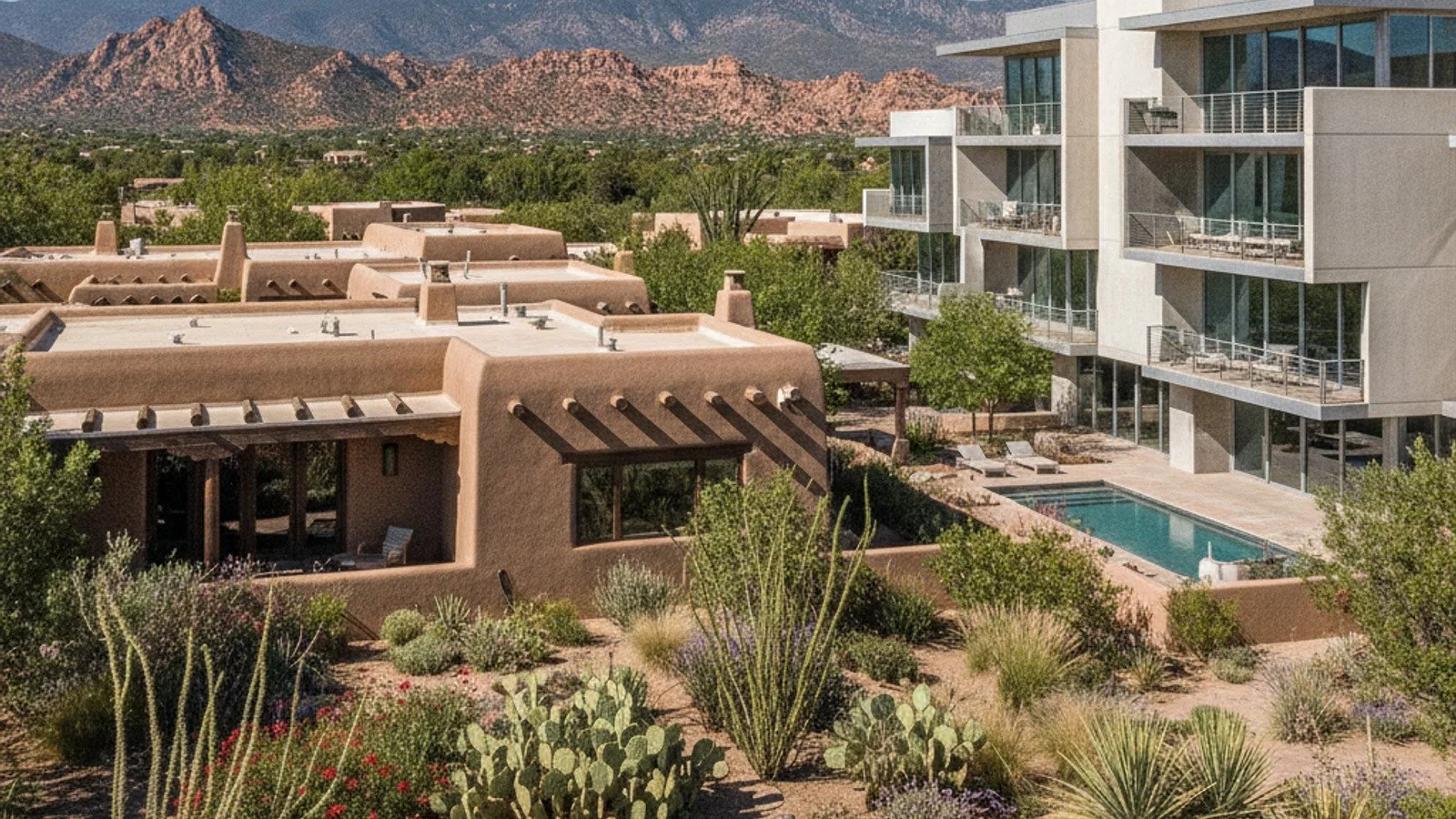
The city's architecture stands out from other markets due to the prevalence of Adobe, Pueblo Revival, and Territorial styles. Many buyers specifically seek out these traditional designs, which often feature flat roofs, exposed wooden vigas, and kiva fireplaces. The local historic design review board regulates exterior modifications in certain districts to preserve this aesthetic.
Beyond single-family homes, the market includes a steady supply of modern condos and townhomes. These attached properties often appeal to buyers looking for lower-maintenance options or secondary residences. Buyers purchasing luxury properties must account for a local high-end excise tax that applies to home purchases over $1,029,000.
Property lines and lot sizes vary dramatically across different parts of the city. Homes closer to the plaza generally sit on smaller, historic lots with limited street parking. Properties in the surrounding foothills often feature acreage, native landscaping, and unpaved access roads.
Homeowners associations govern many of the newer subdivisions on the city's south side. These organizations manage shared amenities and enforce community design standards. Buyers should factor monthly HOA dues into their overall housing budget when looking at these developments.
Everyday Living Costs and Local Taxes
The overall cost of living index in Santa Fe runs higher than both the state and national averages. Much of this premium stems from housing costs, though everyday expenses like groceries and utilities also reflect the realities of a high desert location. Water conservation measures and heating costs during the snowy winter months factor into monthly utility bills.
Grocery expenses align with other mid-sized western cities, with residents utilizing a mix of national chains and local markets. The Santa Fe Farmers' Market provides access to regional produce, though staple goods generally carry standard regional pricing. Transportation costs remain manageable for most residents due to the city's compact footprint.
Local wages and state income taxes also shape the financial picture for new residents. The city maintains a local living wage standard, set at $15.40 per hour as of March 2026. State income tax brackets range from 1.7 percent to 5.9 percent, depending on household income levels.
Homeowners insurance rates present another variable for buyers to consider. Properties located near the national forest boundaries often require specific wildfire coverage policies. Working with a local insurance broker helps buyers accurately estimate these annual carrying costs.
How Property Taxes Work
New Mexico uses a fractional assessment system to calculate property taxes. The taxable value of a home is set at one-third of its assessed market value. This structure often surprises buyers coming from states that tax the full assessed value.
The effective property tax rate in Santa Fe sits at roughly 0.54 percent. This rate keeps annual property tax bills relatively low compared to the national average, offsetting some of the higher upfront housing costs. Buyers should verify the exact mill levy for their specific address, as rates vary slightly depending on the exact location within the county.
Property tax bills are typically mailed in November and can be paid in two installments. Title companies handle the initial tax prorations during the closing process. New buyers should expect their assessed value to update after the first year of ownership to reflect the recent purchase price.
Parks, Healthcare, and Daily Amenities
Outdoor recreation access defines much of the daily routine for residents in this region. The city maintains numerous public green spaces, including Fort Marcy Park and the central Santa Fe Plaza. Just outside the city limits, the Santa Fe National Forest provides extensive access to the Sangre de Cristo Mountains.
Hikers and mountain bikers frequently use the Dale Ball Trails, a 25-mile network located in the foothills. These trails connect directly to other regional path systems, offering varying levels of elevation gain. The city's altitude means newcomers should give themselves time to acclimate before taking on the steeper routes.
Winter sports enthusiasts benefit from the nearby Santa Fe Ski Basin, located just 16 miles from the downtown plaza. The high elevation provides reliable snow coverage during the winter months. During the summer, these same mountain areas offer cooler temperatures for hiking and camping.
Golfers have access to several municipal and private courses designed to incorporate the natural high desert terrain. The city also operates multiple recreation centers equipped with indoor pools and fitness facilities. These indoor options provide year-round exercise spaces when winter weather limits outdoor activities.
Medical Care and Cultural Centers
Christus St. Vincent Regional Medical Center serves as the primary healthcare facility for the area. The hospital provides comprehensive medical services, emergency care, and specialized treatment options. Residents also have access to various urgent care clinics and private practices spread throughout the city.
The local arts scene extends well beyond traditional galleries. The immersive art installation Meow Wolf anchors the city's modern cultural offerings, drawing both locals and international visitors. World-class art galleries line Canyon Road, showcasing everything from historic Native American pieces to contemporary works.
Specialized medical care sometimes requires a trip outside the immediate area. While the local hospital handles most needs, certain complex procedures may necessitate a referral to larger facilities in Albuquerque, NM. The drive between the two cities takes about an hour under normal traffic conditions.
The performing arts community adds another layer to the city's cultural landscape. The Santa Fe Opera hosts an internationally recognized summer season in a partially open-air venue. Local theaters and music venues provide year-round entertainment options for residents.
Local Schools and Higher Education Options
The Santa Fe Public Schools district serves the majority of the city and surrounding county areas. District boundaries cover a large geographic footprint, so buyers should verify specific school assignments for any property they consider. The district manages multiple elementary, middle, and high schools, alongside several charter school options.
Several private educational institutions operate within the city limits. These schools offer alternative curriculums ranging from college preparatory programs to experiential learning models. Parents relocating to the area should research enrollment deadlines well in advance of their move.
Higher education and research institutions play a large role in the local economy. Santa Fe Community College offers vocational training, associate degrees, and continuing education programs. St. John's College provides a four-year liberal arts curriculum centered on a great books program.
The Job Market and Research Facilities
The proximity to Los Alamos National Laboratory shapes the regional job market and educational landscape. Located about 35 miles away, the laboratory employs thousands of scientists, engineers, and support staff. This facility drives a steady demand for housing and continuous education in the surrounding communities.
State government operations also provide a stable employment base within the city. As the state capital, Santa Fe hosts numerous administrative offices, legal firms, and related contracting businesses. Remote workers increasingly choose the area for its lifestyle amenities, utilizing local coworking spaces and upgraded broadband networks.
Small businesses and entrepreneurial ventures make up a sizable portion of the local commercial sector. The city supports numerous independent retailers, restaurants, and professional service providers. The local chamber of commerce provides networking resources for new residents looking to establish a business.
Commuting and Transit Around the City
The average commute time for local workers runs between 21 and 25 minutes. Most residents rely on personal vehicles to get to work, utilizing major routes like I-25 and US-84/285. Traffic patterns remain relatively predictable, though the summer tourist season can increase congestion around the downtown plaza.
Regional connectivity allows professionals to work across different parts of northern New Mexico. I-25 provides a direct route south to Albuquerque, NM, while US-84/285 connects the city to communities further north. Winter weather occasionally impacts driving conditions on these higher-elevation routes.
The city continues to expand its dedicated bicycle infrastructure along major corridors. Paved multi-use paths parallel several main roads, offering safer routes for cyclists and pedestrians. These paths connect residential neighborhoods directly to commercial centers and public transit hubs.
Electric vehicle adoption continues to grow across the region. The city has installed public charging stations at various municipal buildings and parking garages. Buyers planning to commute with an electric vehicle should verify the charging infrastructure along their specific route.
Public Transit and Flights
The New Mexico Rail Runner Express offers an alternative to highway driving. This commuter train connects Santa Fe to Albuquerque, NM, making stops at various pueblos and suburban stations along the way. Within the city, the Santa Fe Trails bus system operates multiple routes covering major commercial and residential zones.
For longer trips, the Santa Fe Regional Airport provides commercial flights to major hubs. Travelers can connect through cities like Dallas and Denver without making the drive to the larger Albuquerque International Sunport. The local airport's smaller size allows for quicker security lines and easier parking.
The airport terminal recently underwent upgrades to accommodate increased passenger volume. These improvements include expanded parking facilities and updated waiting areas. Travelers appreciate the convenience of flying locally rather than driving down to the larger regional hubs.
Frequently Asked Questions
What is the median home price in Santa Fe right now?
Current data shows the median home sale price sitting between $525,000 and $580,000 in 2026. Prices depend on the property's size and its distance from the historic downtown area. Buyers should expect higher price tags for traditional adobe homes in established areas.
How are property taxes calculated in Santa Fe County?
The county uses a fractional system where only one-third of a home's assessed market value is subject to taxation. This taxable value is then multiplied by the local mill rate, resulting in an effective tax rate of about 0.54 percent. This system keeps annual tax bills lower than what buyers might pay in other states for a similarly priced home.
Does Santa Fe have public transportation?
Yes, the city operates the Santa Fe Trails bus system for local trips. Commuters traveling to Albuquerque, NM can use the New Mexico Rail Runner Express, a train service connecting the two cities. These options provide alternatives to driving on I-25 during peak hours.