
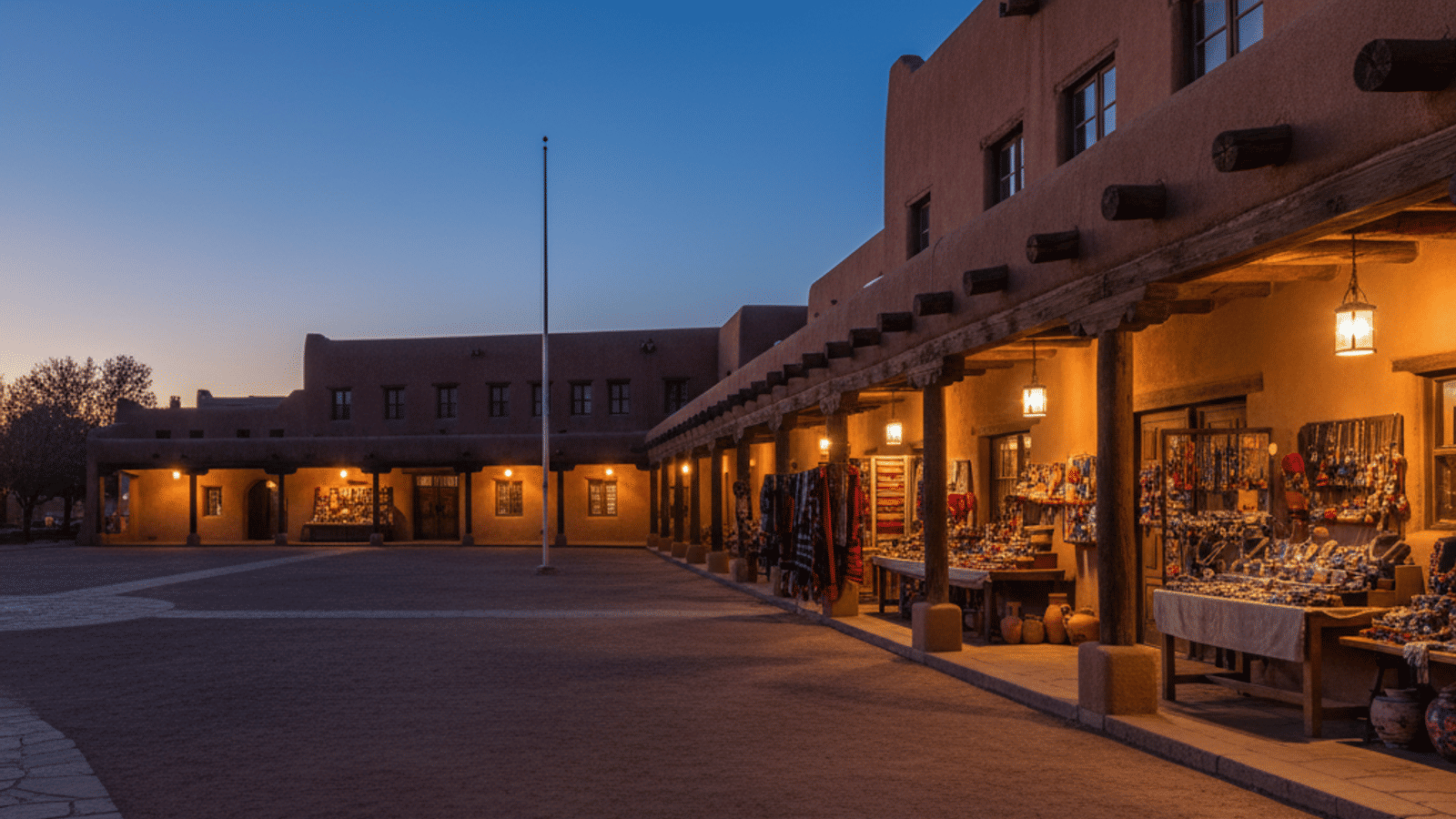
If you have ever stood in the Santa Fe Plaza on a crisp evening, smelling the scent of piñon smoke in the air, you know this city feels different. It isn’t just the adobe architecture or the high-desert light that has captivated artists for a century; it is the sheer weight of time. While many American cities measure their history in decades, Santa Fe measures its timeline in centuries.
Officially founded in 1610, Santa Fe holds the title of the oldest state capital in the United States. Its full original name—La Villa Real de la Santa Fé de San Francisco de Asís—hints at the regal and religious ambitions of its Spanish founders. Sitting at an elevation of roughly 7,000 feet at the foot of the Sangre de Cristo Mountains, the city has been a crossroads of culture, trade, and conflict long before the United States even existed.
For anyone thinking about living in Santa Fe or just visiting, understanding this timeline changes how you see the streets. You aren’t just looking at old buildings; you are walking through a living museum that has survived revolts, changing flags, and the arrival of the railroad. Let’s take a walk back through time to see how this high-desert outpost became the "City Different."
Indigenous Roots and Early Settlement
Long before Spanish boots ever touched this soil, the area was already a thriving center of life. Around 900 AD, a Tewa village known as Ogapoge, or "White Shell Water Place," occupied the very ground where downtown Santa Fe sits today. The Tewa people and other Indigenous groups had established complex pueblo settlements up and down the Rio Grande Valley, utilizing the river and the mountains for agriculture and shelter.
When Spanish conquistadors arrived in the region in the 16th century, they found a civilization that was already ancient. However, the formal European chapter of the city began in 1610 when Don Pedro de Peralta established the capital. It was Peralta who laid out the Plaza and began construction on the Palace of the Governors.
That structure is still standing today on the north side of the Plaza. It holds the distinction of being the oldest continuously occupied public building in the United States. When you look at its thick adobe walls, you are looking at the literal seat of government that predates the landing at Plymouth Rock by a decade.
The Pueblo Revolt of 1680 and Spanish Return
The relationship between the Spanish colonizers and the Pueblo people was fraught with tension from the start. The Spanish imposed their legal system and religion, often suppressing Indigenous spiritual practices. This pressure cooker exploded in 1680 in what is known as the Pueblo Revolt.
Led by a majestic Ohkay Owingeh leader named Popé, the Pueblo people coordinated a massive uprising that successfully drove the Spanish out of New Mexico entirely. For the next 12 years, the Spanish remained in exile in what is now El Paso/Juarez, while the Pueblo people reclaimed their capital. During this time, the Palace of the Governors was remodeled into a pueblo-style dwelling.
The Spanish eventually returned in 1692 under Don Diego de Vargas. This event, often described in older texts as a "bloodless reconquest," was actually a complex series of negotiations and conflicts that eventually re-established Spanish rule. Today, the complex legacy of these events is remembered during the annual Fiestas de Santa Fe, a tradition that remains a deeply ingrained, though sometimes controversial, part of the city's cultural fabric.
The Mexican Era and the Santa Fe Trail (1821–1846)
For over two centuries, Santa Fe was an isolated outpost of the Spanish Empire, forbidden from trading with the French or Americans. That isolation ended abruptly in 1821 when Mexico won its independence from Spain. The new Mexican government was eager for trade, and the gates were thrown open.
Almost immediately, a Missouri trader named William Becknell blazed the Santa Fe Trail. This commercial highway connected the United States frontier in Missouri directly to the Santa Fe Plaza. Suddenly, American goods—calico, tools, and hardware—flooded the market, and silver and furs flowed back east.
This era brought a massive economic boom and shifted the cultural tide. Anglos began to settle in the area, marrying into local families and influencing the architecture and lifestyle. If you visit the Plaza today, you can find a stone marker commemorating the "End of the Trail," a reminder of when this square was the most important international trading hub in the West.
U.S. Territory, the Civil War, and the Railroad
The map changed again in 1846. During the Mexican-American War, General Stephen W. Kearny marched his Army of the West into Santa Fe and claimed New Mexico for the United States without firing a shot. But the city's military history wasn't quite over. In 1862, during the Civil War, Confederate troops actually occupied Santa Fe for a few days before being pushed back at the decisive Battle of Glorieta Pass.
The biggest change, however, was technological. In 1880, the railroad finally arrived. While the main line bypassed Santa Fe for the easier terrain of Albuquerque, a spur line was built to Lamy, just south of town. The train brought heavy machinery, metal roofs, and fired bricks.
This influx of materials gave rise to the "Territorial" architectural style you still see today. It also brought Archbishop Jean-Baptiste Lamy, a French clergyman who decided the city needed a proper European-style cathedral. He commissioned the Romanesque St. Francis Cathedral, which was started in 1869. Its sharp stone spires stand in stark contrast to the low-slung adobe surroundings, a permanent reminder of the city’s layer-cake history.
Statehood and the Birth of "Santa Fe Style" (1912–Present)
New Mexico finally achieved statehood in 1912. Around this same time, city leaders made a brilliant, conscious decision that saved Santa Fe from looking like every other American town. Realizing that tourism was their best economic bet, they rejected the standard grid plans and brick buildings becoming popular elsewhere.
Instead, they championed the "Pueblo Revival" style. This aesthetic emphasized flat roofs, rounded corners, and earth tones that mimicked the landscape. It was a romanticized version of the city's roots, but it worked. It attracted artists, writers, and eventually, the scientists of the Manhattan Project.
In 1943, a nondescript office at 109 East Palace Avenue became the secret gateway to Los Alamos. Scientists like Oppenheimer would check in here before being whisked away to "The Hill" to develop the atomic bomb.
To protect this unique atmosphere, the city passed the Historic Zoning Ordinance in 1957. This landmark legislation legally protected the architectural character of the city. It is the reason why, even in early 2026, you won't see skyscrapers or neon-flashing billboards in the historic districts.
Exploring Santa Fe’s Historic Districts and Architecture
For those looking at homes for sale in Santa Fe historic districts, understanding the specific neighborhoods helps you appreciate the price and the vibe. The city is a patchwork of protected areas, each with a different flavor.
Barrio de Analco Located across the Santa Fe River from the Plaza, this is one of the oldest European residential neighborhoods in the U.S. It is home to the "Oldest House" on De Vargas Street. The streets here are narrow, winding, and lined with authentic adobe homes that feel grown from the earth.
The Plaza & Downtown This is the commercial heart. The architecture here is grander, featuring deep portals (porches) where Native American artisans sell jewelry under the governor's protection. It is walkable, busy, and steeped in history.
Canyon Road Once a humble farming road leading into the mountains, Canyon Road evolved into a world-famous artist colony. Today, it is one of the densest concentrations of art galleries in the country. The homes here are often historic adobes converted into studios and showrooms.
Architectural Styles to Know When house hunting, you’ll hear two main terms:
Pueblo Style: Think soft, rounded edges, real or stucco adobe, and exposed vigas (beams) protruding from the walls.
Territorial Style: This is the sharper, "tidier" look introduced after the US takeover. Look for brick coping along the rooflines and squared-off columns painted white.
How History Shapes Santa Fe Today
The history of Santa Fe isn't just in the guidebooks; it dictates the modern lifestyle. The strict preservation laws that began in the 1950s have maintained property values and kept the skyline open to the mountains. When you look at Santa Fe architectural styles, you realize that owning a home here comes with a stewardship responsibility.
The art scene, which exploded in the 1920s with the arrival of the "Los Cinco Pintores" (The Five Painters), has turned the city into the third-largest art market in the U.S. Events like the Santa Fe Indian Market are direct descendants of the centuries-old trade gatherings on the Plaza.
Today, living in Santa Fe offers a rare blend of modern amenities and deep heritage. You have access to world-class opera and dining, yet you walk streets laid out for mule carts. It is a place where the past is always present, offering a richness that few other American cities can match.
Frequently Asked Questions
How old is Santa Fe, New Mexico?
Santa Fe was officially founded by the Spanish in 1610, making it over 415 years old as of 2026. However, the site was occupied by Indigenous peoples, specifically the Tewa village of Ogapoge, for centuries prior to European arrival.
Why is Santa Fe called "The City Different"?
The nickname "The City Different" emerged in the early 20th century as part of a deliberate effort to brand the city for tourism. Civic leaders pushed to preserve the unique Pueblo-Spanish architectural style and reject the industrial "Anytown, USA" look that was sweeping the country at the time.
What is the oldest building in Santa Fe?
The Palace of the Governors on the Plaza is the oldest continuously occupied public building in the U.S., dating back to 1610. For residential structures, the house at 215 East De Vargas Street is often cited as the "Oldest House," with foundations that may date back to roughly 1200 AD.
Did the Santa Fe Trail end in the Plaza?
Yes, the historic Santa Fe Trail, which began in Missouri, officially terminated at the Santa Fe Plaza. You can still find a stone marker on the southeast corner of the Plaza commemorating the end of this vital 19th-century trade route.