
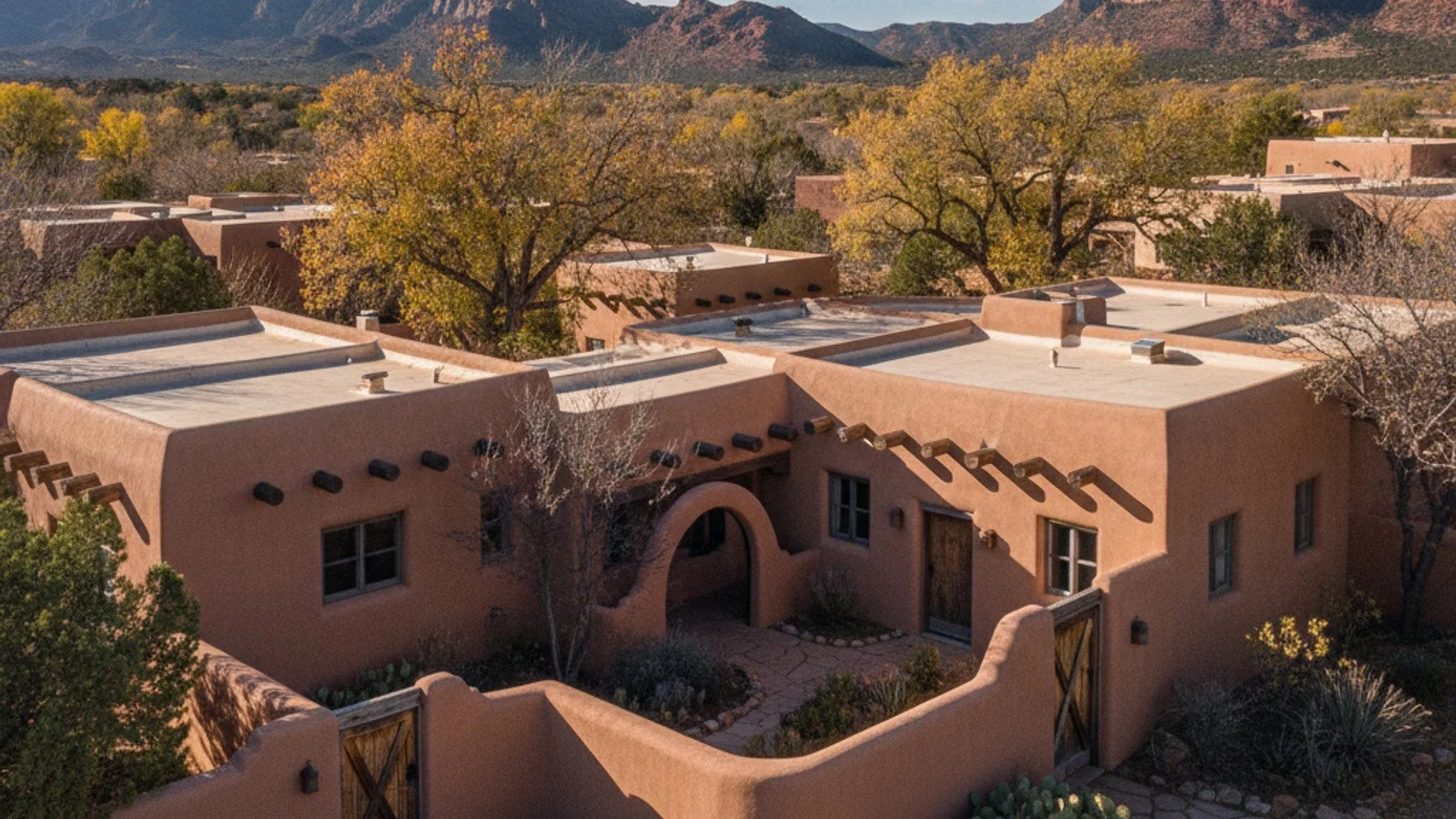
At an elevation of 7,200 feet, Santa Fe, NM sits higher than Denver and offers a distinct high-desert environment. The city sits at the foothills of the Sangre de Cristo Mountains, combining centuries of history with modern amenities. It operates as the state capital while maintaining the scale and feel of a smaller community.
Researching the reality of Living in Santa Fe, NM requires understanding the local real estate pricing, specific tax structures, and transportation options. Buyers often focus on the unique adobe architecture, the established art market, and the four-season climate. Moving here means preparing for a housing market that operates differently than many other parts of the United States.
What to Expect in the Santa Fe Housing Market
The median home price in Santa Fe typically ranges between $680,000 and $800,000, depending on the specific neighborhood and proximity to the historic center. Buyers will find a mix of single-family homes, townhouses, and condos. Inventory often features distinct regional architectural styles that require specific maintenance routines.
Pueblo Revival and Territorial adobe designs dominate the local market. These homes feature flat roofs, earth-toned stucco, and exposed wooden beams called vigas. Buyers should factor annual maintenance for these specific exterior materials into their ongoing budget.
Property Taxes and Buyer Fees
New Mexico maintains relatively low property taxes compared to the national average. The effective county property tax rate in Santa Fe is roughly 0.46%. For a median-priced home of $750,000, the annual tax bill sits around $3,450.
Buyers purchasing luxury properties must account for a specific local fee introduced recently. As of May 2026, residential purchases exceeding $1,029,000 are subject to a 3% High-End Excise Tax. This tax applies only to the portion of the sale price that falls above that threshold.
Local Jobs and Healthcare Options
State government and federal research facilities form the backbone of the Santa Fe economy. Los Alamos National Laboratory operates nearby and employs thousands of residents across various scientific and administrative disciplines. The tourism and hospitality sectors also provide a steady stream of employment opportunities year-round.
The city ranks as the third-largest art market in the United States. This concentration of galleries, museums, and independent artists drives a large portion of the local economy. Beyond the arts, healthcare stands out as a major regional employer.
Christus St. Vincent Regional Medical Center serves as the primary healthcare facility for the area. This hospital provides comprehensive medical services, emergency care, and specialized treatment centers. Residents do not have to travel to Albuquerque for most routine or urgent medical needs.
Commuting and Public Transportation
Interstate 25 serves as the primary highway connecting Santa Fe to Albuquerque and other regional hubs. The drive to Albuquerque takes about an hour under normal traffic conditions. Within the city limits, major thoroughfares like Cerrillos Road and St. Francis Drive handle the bulk of daily commuter traffic.
The New Mexico Rail Runner Express offers a direct alternative to highway driving. This commuter train connects Santa Fe to downtown Albuquerque, with the ride taking approximately 90 to 105 minutes. Many professionals use this service to avoid rush hour congestion on I-25.
Local transit relies on the Santa Fe Trails bus system. These buses run throughout the city limits, connecting residential areas to commercial centers and the downtown plaza. The city has focused on expanding these routes to serve more neighborhoods over the past few years.
Santa Fe Public Schools and Education Options
The Santa Fe Public Schools district covers a large geographic area, extending beyond the immediate city limits. The district offers traditional neighborhood schools, along with several charter and magnet options. Parents should verify specific attendance zones when looking at homes, as boundary lines can shift based on enrollment numbers.
Several specialized academies operate within the local public school system. The Academy for Technology & the Classics and the New Mexico School for the Arts provide focused curriculums for enrolled students. Admission to these specialized programs often involves a separate application process.
The district is currently consolidating its student support services into the Educational Services Center. This central hub streamlines administrative tasks, special education resources, and enrollment procedures. Bringing these services under one roof makes it easier for new residents to register their children.
Weather and Outdoor Recreation
Santa Fe receives roughly 300 days of sunshine each year. The high-desert climate features low humidity and four distinct seasons, including summer monsoons and winter snowfall. Summer high temperatures typically stay in the 80s, while winter nights frequently drop below freezing.
The surrounding landscape provides immediate access to miles of public land. The Santa Fe National Forest and the Dale Ball Trails offer extensive networks for hiking and mountain biking just outside the city limits. Residents can reach trailheads within a ten-minute drive from most neighborhoods.
Winter recreation centers around the Sangre de Cristo Mountains. Ski Santa Fe operates a short drive up the mountain from the downtown area, offering downhill skiing and snowboarding. The base elevation of 10,350 feet ensures consistent snow coverage from late fall through early spring.
Local Arts, Dining, and Entertainment
Canyon Road features more than a hundred art galleries packed into a half-mile stretch. This historic district serves as the focal point of the city's traditional and contemporary art scene. A short distance away, the Santa Fe Plaza functions as the main community gathering space for events and festivals.
The Santa Fe Farmers Market operates year-round near the historic rail yard. Vendors sell local produce, roasted green chiles, and handmade goods every week. Nearby, the Georgia O'Keeffe Museum and the immersive Meow Wolf art installation draw both residents and visitors.
Local dining centers on traditional New Mexican restaurants. Establishments throughout the city serve dishes featuring the region's famous red and green chile. A growing number of local breweries also operate in the area, offering craft beer and casual outdoor seating.
Frequently Asked Questions
What is the cost of living in Santa Fe, NM?
Housing costs drive the overall expense of living in the area, with median home prices hovering around $750,000. Everyday expenses like groceries and utilities align closely with national averages. However, the 0.46% county property tax rate helps offset some of the higher upfront housing costs.
What is the weather like in Santa Fe, NM throughout the year?
The city experiences a high-desert climate with four distinct seasons and low humidity. Summer temperatures rarely exceed 90 degrees, while winter brings regular snow to the surrounding mountains and occasional dustings in town. Residents enjoy clear skies for about 300 days out of the year.
What is the job market like in Santa Fe?
Government agencies and Los Alamos National Laboratory provide the most stable, high-paying employment in the region. The hospitality and tourism industries also employ a large percentage of the local workforce. Meanwhile, the robust gallery scene supports independent artists and retail professionals.